
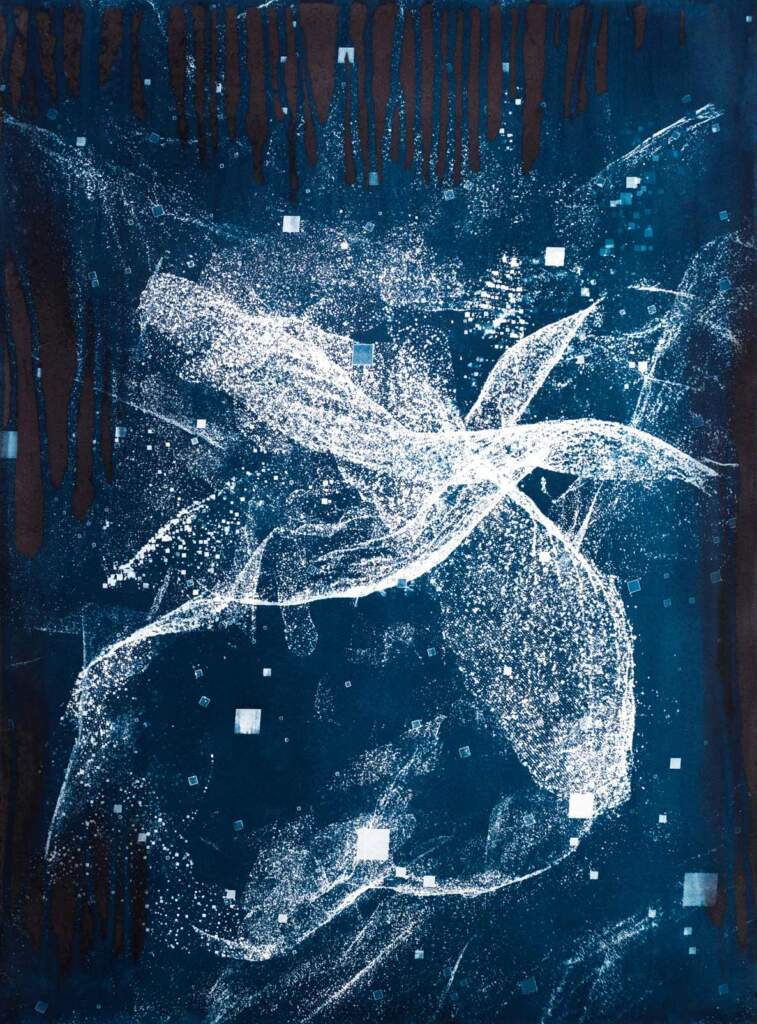
Jošt Dolinšek: To Move the Sun and Earth Away & Elí Joteva: Biogram Blueprints
4 May – 25 May 2021
In the Photon gallery, we have been juxtaposing two artists in the “Artist Dialogue” section for several years. It is mainly dedicated to photographers of the younger and middle generation from the former Yugoslavia and the Central-East Europe region.
This year, the term “dialogue” is placed in the additional context of the Open Call Different Worlds, which we organize annually at Photon Gallery. The Open Call, aimed at young emerging artists in the field of contemporary art photography in the region CEE and Austria, ran in its 8th edition in 2020. This year’s dialogue brings together two finalists from two different editions, the winner of 1st place in 2020, Jošt Dolinšek (Slovenija) and the winner of 3rd place in 2018, Elí Joteva (Bulgaria). Their work is connected with a conceptual approach to photography and innovative technical solutions. They will present two independent projects, each in its own space of Photon Gallery.
To Move the Sun and Earth Away
To Move the Sun and Earth Away is a photographic and sound project exploring the human perception of the environment – how we comprehend it, its deceptions, and how deeply is rooted our sense of otherness in relation to nature. Otherness is ubiquitous and its latent effects have a huge impact on our culture and power structures. How biased is our perspective on the environment and its past? A question like this prompted another, and another, until I found myself contemplating the issues such as discovering the truth, living in denial and fear, as well as the reasons for detachment. One of the key ideas behind this work is the concept of dualism – a stance of clear distinction and separation between two entities. The physical form of installation developed from this idea, i.e., questioning the significance and bias originating from omnipresent dualisms, such as truth vs. falsity, hiding vs. revealing, accepting vs. avoiding & denying, and fact vs. fiction.
The mirrors in front of the photographs blur a direct view of the images, thus allowing practically innumerable perspectives and perceptions of the photographs. Recently, I have focused on the exploration of sculptural aspects of photography and the idea of a photograph as a subliminal object that to be fully perceived, it needs to be explored first. Artwork as a puzzle, which requires a certain input to reach its entirety. In other words, I try to use the capacity of image to reveal what is invisible to us – not exposing the unknown or unseen, but rather discovering an aspect in things and objects that got lost within the depths of our own perception.
The work presented is not about any environmental past, present or future crisis. Environmental impact is just one manifestation of the phenomenon I was interested in. With this series, I question the reasons behind these anomalies, how people cope with them and what feelings they trigger. The selected photographs, paired with sound, depict an atmosphere and a feeling of inanimate nature in decay. Soundscapes draw on the field recordings which were arranged into new pieces. The idea is to create a “perceptual playground”, where viewers would explore the work both visually and auditorily. The intimate experience would absorb the viewer and confront them with our stance on nature and (self)deceit.
Jošt Dolinšek
Biogram Blueprints
Biogram Blueprints is a work that explores the digitization of organic structures through the invisible spectrum of light. At its core, the production process uses measurement techniques from the two ends just outside the visible spectrum of light to illuminate the connection between the visible and the invisible. The accompanying light installation Zero Point Field, inspired by diffraction and quantum subatomic field fluctuations, expands on the relationship between the virtual and the actual by further breaking down the visible spectrum of light. It presents the same spatial information of the 3D scanned plants in a dynamic moving projection that fluctuates them in an interchangeable and diffracted field of particle noise.
The 3D capturing involves infrared depth laser scanning technology to calculate data points of spatial information about the physical dimensions of four living plants. These dimensional portraits are photographed with a virtual camera from multiple perspectives and layered to compose digital negatives. The printing process explores the other end of the invisible light spectrum (ultraviolet light) through one of the oldest methods of photographic printing – cyanotype. As a contemporary ode to Anna Atkins, the project connects the most contemporary imagining technology with the first photographic method, in this way linking the ends of the light spectrum as we see it with the ends of historical time as we know it. All prints are partially developed so that sections of each image remain sensitive to UV light and thus slowly change in response to the precipitation and light in their environment. By flattening the 3D scans into dynamic topographic maps, the project deciphers a dimensional translation of material and digital memory systems.
Elí Joteva
Video tour of the exhibition Jošt Dolinšek in Elí Joteva
Exhibition Jošt Dolinšek in Elí Joteva on RTV SLO

