-
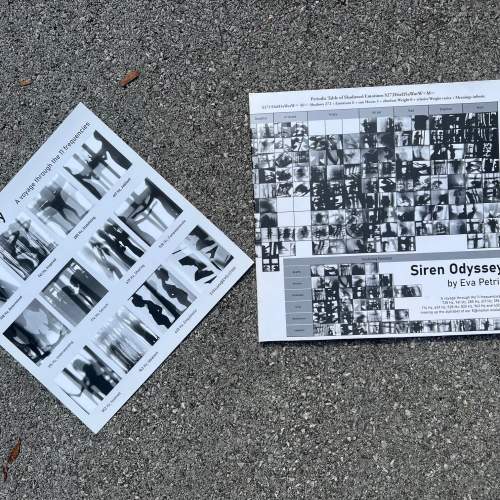
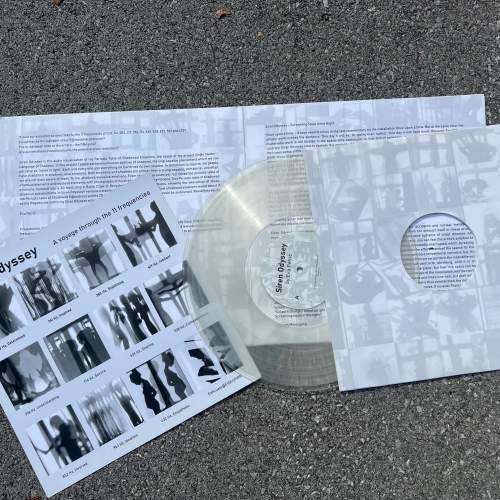 NEW!Siren Odyssey - A voyage through the 11 frequencies of: 728, 741, 285, 417, 396, 174, 639, 528, 825, 963 and 432, making up the alphabet of our E@motion evolution. Could they be the alphabet of our emotional evolution? The in-between links or the errors – the DNA junk? Are our emotions evolutional junk, the potential of our evolution? Syren Oddissey is an audio visualization of my Periodic Table of Shadowed Emotions, the result of Eva's project Gr@y Matter – Language of Shadows. Frequencies of pitch have been associated with different moods, and the earth and the human body have different resonant frequencies associated with them. For the individual selected frequencies in Siren Odyssey, Eva tried to find textures and grooves that complemented the particular frequencies that were presented to her. The sounds you hear are all tuned to be consonant with the base frequency and therefore should amplify the feeling associated with that particular frequency. Vinyl record in sleeve. Text: Dr.Thomas Miessgang Vocals, lyrics, sound, composition and concept: Eva Petrič Sound production and synthesizer: Mydeck 2000 NYC Scene: installation of recycled lace assemblages by Eva Petrič Video projections: Eva Petrič Performance: Eva Petrič An A4 fine art print of all the shadow images is added, representing the 11 frequencies.
 -
 NOVO!Limited Edition Print // Edition of 50 Photon Gallery Exclusive The photograph is printed on Ilford archival semi-matte 290g paper. The entire edition is printed with a white border (1,5 cm) in the dimension 48 x 39 cm (including the white border). With each print, you will receive a certificate of authenticity.
 -
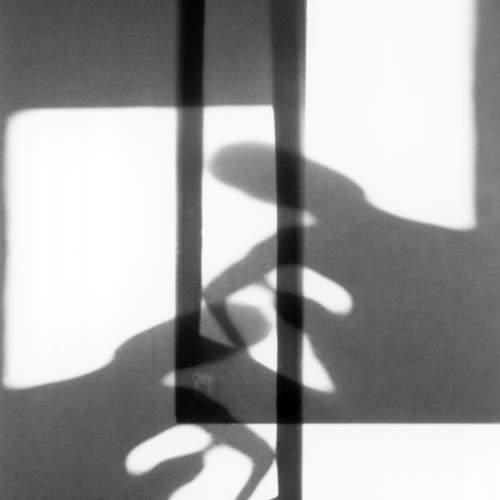 NEW!Limited Edition Print // Edition of 50 Photon Gallery Exclusive The photograph is printed on Ilford archival semi-matte 290g paper. The entire edition is printed with a white border (1,5 cm) in the dimension 48 x 39 cm (including the white border). With each print, you will receive a certificate of authenticity.
 -
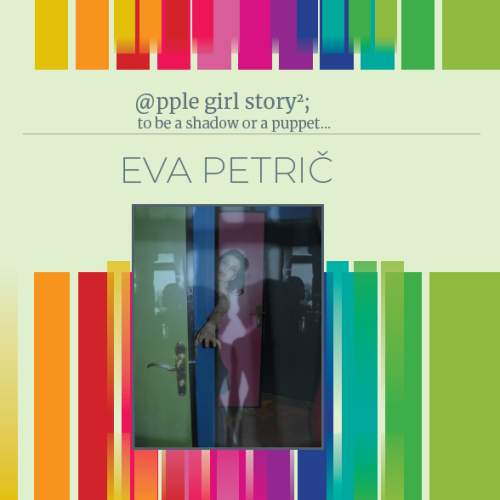 NEW!What will our world be like without emotions, and will anyone even miss them? This question, provoked by the concern that life in current circumstances of constant digital connectivity and instant “likes” and emoticons” is heading into a state where emotions are increasingly losing their role and are retreating into cliches, has motivated the visual artist and author Eva Petrič to create ”@apple girl story 2 ; to be a shadow or a puppet…”. The multilayered story and its book is a hybrid by its content as well as its form. It is a hybrid of a literary story, switching between a fairytale and a contemporary email dairy, and the visual dictionary of emotions among which many are on the brink of extinction. The text itself is a hybrid mitigating between images and sentences, spread out over paper of different colors in ways where sentences form visual images. By depicting figures in their material forms of bodies as well as in their immaterial forms as shadows, the book enables viewers various ways of perception and possibilities of creating one’s own stories. Eva Petrič is a transmedia artist, known for her creative use of photography, interweaving with other media, exploring with it the language of shadows, decoding our existence on ephemeral levels. Her motivation to expose the multidimensional architecture of space, defined by atmosphere, lead her to apply a trans medial approach in her art. Author: Eva Petrič Foreword: Olga Butinar Čeh 23 cm x 23 cm 358 pages, hardcover
 -
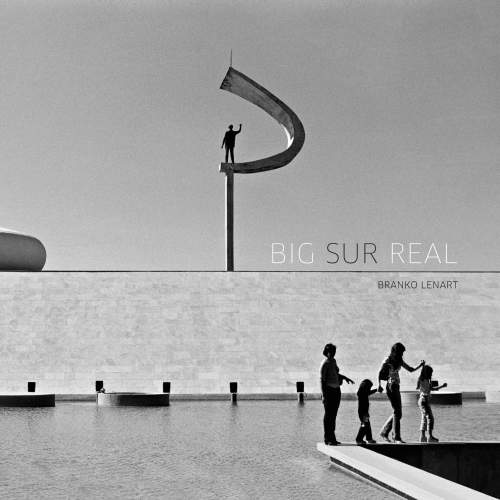 Big Sur Real. In his latest book project, Branko Lenart has focused on the process of choice as a creative act. He has collected 119 photographs from 1970 to 2020 under the title "BIG SUR REAL". Branko Lenart (1948, Ptuj, Slovenia) was born in the former Yugoslavia, but his family emigrated to nearby Austria when he was six years old. He studied pedagogy in Graz and in 1968 became a member of the photography section of the Graz art association Forum Stadtpark, from which Camera Austria later emerged. Until 2007 he was active as a lecturer in photography at the Graz Higher State School of Art and Design (1979 - 2007) and at the Joanneum University of Applied Sciences in Graz (1996 - 2003). Lenart is an internationally renowned photographer who has travelled extensively around the world since his youth, often staying at artist residencies such as the Apeiron Workshops in Millerton, New York, La Rochelle, Arles, Oxford, Rome, Paris and London. His oeuvre is divided between documentary and conceptual auteur photography. He has paid particular attention to the social periphery, to members of the former urban counterculture or rural society, and has coined the term "subjective topography" for this type of photography. Photographs by Branko Lenart Editor: Günther Friesinger Selection of reproductions: Janez Korošin, Primož Lampič Text: Marjeta Ciglenečki, Günther Holler-Schuster Readings: Bokmal Read by Evelyn Fürlinger Year of publication: 2023 Hardcover, 152 pages ISBN: 978-3-902796-89-9
 -
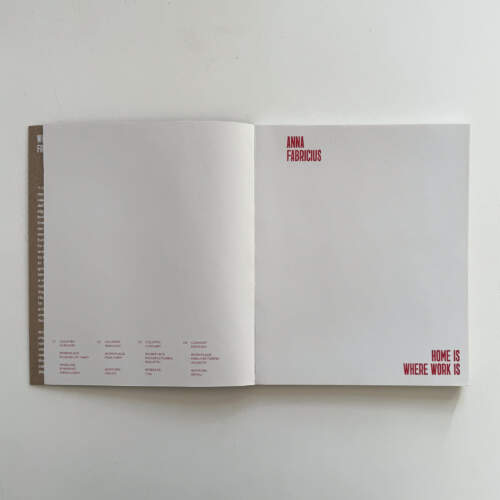
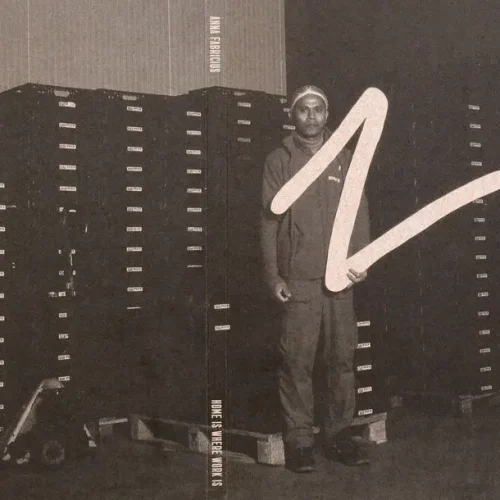 WHAT CAN WE LEARN FROM FOREIGN WORKERS? Anna Fabricius has been researching the changing cultural and personality-shaping role of work for years and is currently investigating the increasingly common transnational family relationships resulting from the global division of labour. She has been collaborating with workers from the Far East (Nepal, Myanmar Thailand, Philippines, India), like Insiyatul Urbayanti, who have been employed for shorter or longer periods in agriculture or in the manufacturing industry. The majority of them are young, poor men and women whose daily lives are charac-terised by restricted freedom of movement, strict daily schedules and low wages. There is a constant migration of labour between the poorer and richer regions of the world, and Hungary is also involved in this exchange both as host and exporter. The project titled "Home Is Where Work Is" addresses some of the most pressing issues of our time, where the discourse on human rights is accompanied by restrictive immigration regulations. In this respect, the title of the project carries several mean-ings. We can conceive of work as an instrument of power that forces people to leave their homes, determines their living spaces, their daily rhythms and their personal relationships. The title also addresses the insecurities of the transitory situation in which one cannot feel at home in their place of birth or in their place of work. Lastly, it refers to the dilemmas between moneymaking work and care work to maintain the family home, and thus to the tensions between the economy, society and the reproduction of culture. Тext: Judit Csatlós, Tibor Meszmann Translation: Dániel Sipos Graphic Design: Adrienn Császar Printing House: EPC ISBN: 978-615-02-1329-3
 -
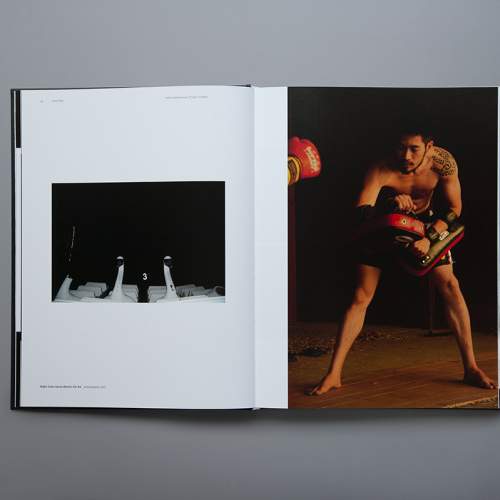
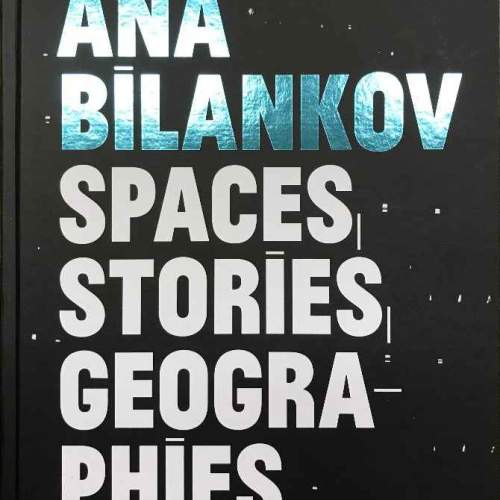 Ana Bilankov's first comprehensive monograph and at the same time an artist's book is structurally conceived as a kind of experimental film, a non-chronological 'storyboard' of her conceptual art works made in the media photography, video / experimental film, installation and text in the last twenty years. Structured into ten chapters, the book raises a series of questions on the subject of poetics/politics of dislocation, migration, nomadism, individual and collective memory and construction of identity within "in-between-ness". Many projects have emerged in diverse geographic contexts thanks to several international residencies in different European cities, Moscow and New York, or in both of the author's hometowns, Zagreb and Berlin. The book includes rich photographic and video material as well as the texts written by the author and also two theoretical essays: "Some Future Film" by the art theorist Leonida Kovač and "The Poetry and Revolution of Ana Bilankov" by the film theorist and philosopher Marijan Krivak, and has been designed by Hamper studio Zagreb. Author: Ana Bilankov Publisher: Hamper studio Zagreb Year: 2019 Hard cover, 223 pages Language: English, Croatian Dimensiones: 29 x 23 cm ISBN: 978-953-48548-0-8
