-
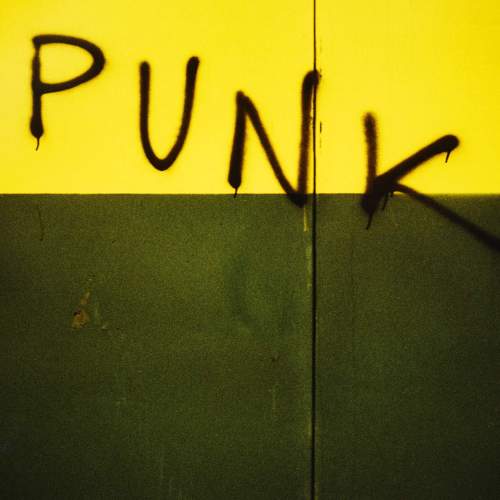 Vojko Flegar (1958) is a law graduate, retired journalist, contributor to Radio Študent and Tribuna, correspondent, commentator and editor of Delo and Dnevnik, and freelance journalist. He was also an occasional photographer who followed early Slovenian punk, rock and alternative music with his camera in the late 1970s and early 1980s, when these marginal creative practises were not yet of interest to most "serious" photographers. His mainly reportage-like ouevre condensed in a relatively short period of three years is focused on the interaction between the performers on stage and the audiences' interventions in public space, especially in the form of graffiti. Some of his photographs, after being published in magazines and on record sleeves from this period, later became part of the visual legacy of this perhaps most subculturally exciting time in Slovenia. Over the last two decades, he has participated in some of Photon Gallery's thematic group exhibitions, such as Laibach Focus (2004), Children of Happiness. Punk Scene of the Early 1980s (2005), Pankrti. Nowt's Getting On (2007), Postering Forbidden. The Story of Buldožer (2015). This work is part of a photographic folder or portfolio box with twenty prints by renowned Slovenian photographic artists from the 1970s to the present day, published on the occasion of the 20th anniversary of Photon Gallery. - The edition is 100 copies, the 40 x 50 cm photographs are printed on archival paper, the prints are signed and accompanied by certificates.
 -
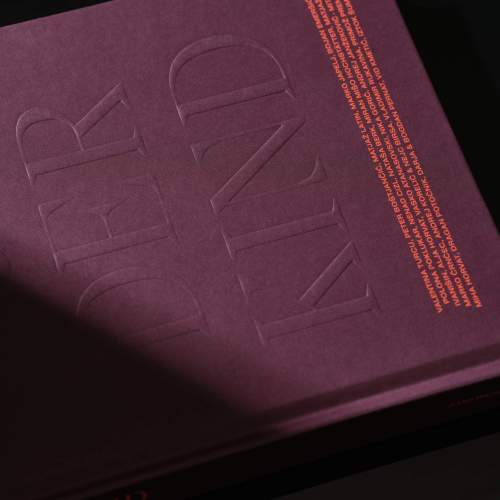
 NEW!The book is a tribute to portrait photography, enriched with interviews with individuals who create excellence and strengthen the positive energy of the city. The subjects reveal fragments of their personal experiences, creative processes, and lives in general. Each of them has made a profound mark on their field, be it theater, music, visual arts, or urban culture. What they all have in common is that they raise the cultural capital of the city. Because of them, Maribor is truly a Vunderkind - Katja Gönc Publisher: Visual communications, Sami Abder Rahim Author(s) of the text(s): Marko Radmilovič, Jaša Lorenčič, Uroš Dokl, Katja Gönc Year of publication: 2022 Dimensions and number of pages: 215 × 285 × 30 / 312 pages Hardcover
 -
Sale!
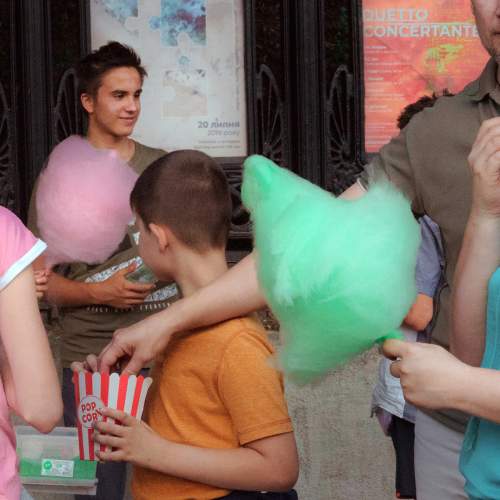 NOVO!Dimensions: 45 x 30 cm + black frameAll prints are printed on fine-art 100 % cotton paper
 -
Sale!

 NEW!Žiga Leški Kosič (1997) is finishing his photography studies at the Faculty of Applied Sciences – VIST. He started his creative journey with graphic design, which sparked his interest in different visual languages. He likes to experiment with different photographic techniques and combines them with graphic approaches to achieve the desired visual results. Most of his work is commissioned, but he also managed a photo editing workshop that was part of FotoVista, he also tried himself as a juror of the [re]freeŠn photography competition and presented himself at two group exhibitions. Selected works with a large format camera create an archive of operational and abandoned industrial buildings, infrastructures and spaces that are often hidden from the public eye. The author is attracted by the sharpness and roughness of the depicted motifs, which he transforms into aestheticized lines with a graphic approach and technical precision.The photograph is printed on archival matt 290g paper. The entire edition is printed with a white border in the dimension 40 x 50 cm (including the white border). With each print, you will receive a certificate of authenticity. Each print (photograph) comes in an edition of 50.
 -
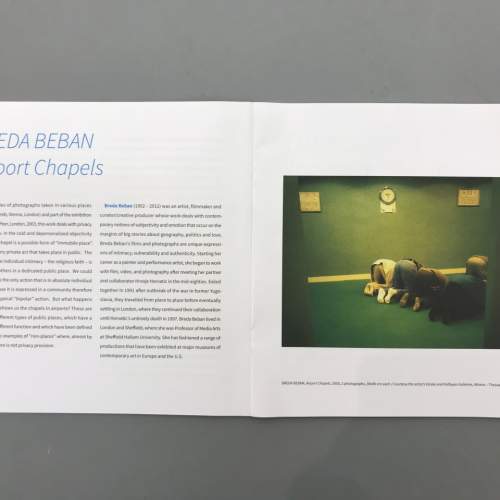
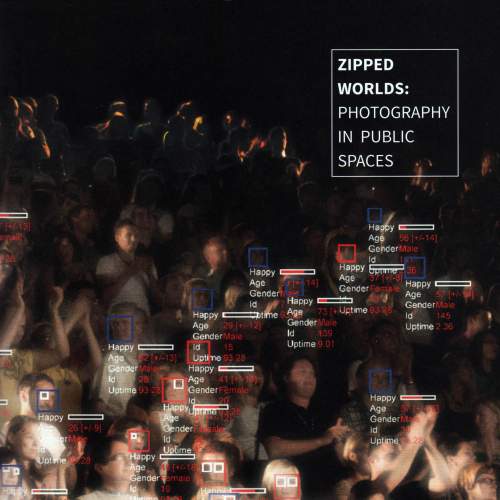 Zipped Worlds is the exhibition catalogue of the project which aims to explore ways of how the photography is used nowadays and to question new concepts of public and private space. The publication contains two essays and a display of 10 participating artists and artist groups. Authors: Giuliana Carbi, Dejan Sluga Publisher: Photon – Centre for Contemporary Photography Year: 2015 Paperback, 44 pages Edition: 300 copies Dimensions: 20 x 20 cm Language: English
 -
 Zmago Jeraj 's series of photographs on the theme of Carnival spans thirty years. The first photographs were taken by chance, merely for the artist's personal archive, with no intention of exhibiting them. Moreover, the initially opportune subject matter was not considered potentially valuable for sustained creative interest. Over time, however, the number of images of figures and scenes associated with Carnival grew and developed into a series. The majority of the shots were taken in the Slovenian town of Ptuj, known for its carnival parade and for the unique carnival figure of "kurent" and its companions. After 1984, when a carnival festival was also organized in Maribor, Jeraj began documenting events in both cities. He focused on masked figures appearing alone or isolated in a crowd of ordinarily dressed people, or on small groups of costumed figures accompanied by random companions. He was interested in homemade costumes, which were often clumsily fashioned and gave a clear indication of the person's ingenuity, skill, and finances. Although Jeraj creates his visual reality with his choice of the event and the moment of freezing it in time, his series of photographs is not without traits of reportage photography and its verism. The outskirts of the center of Ptuj with derelict industrial buildings provide a suitable setting for these images. The emphasis on the banality of the setting robs the carnival figures of their power and creates the semantic concept that prevails throughout the series Carnival Figures and aims to degrade the spectacularity of the figures in various ways. It is thus expressed only with vague allusions to the marginal significance of the costume in relation to the prosaic whole, underlining the futility of the figure's presence. Author: Zmago Jeraj Text: Milojka Kline Publisher: Umetnostna galerija Maribor Year: 1996 Hard cover, 78 pages Print run: 500 Language: english, slovene Dimensions: 30 x 21 cm
 -
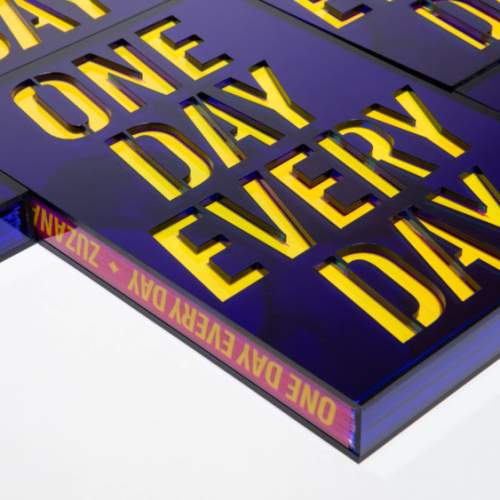
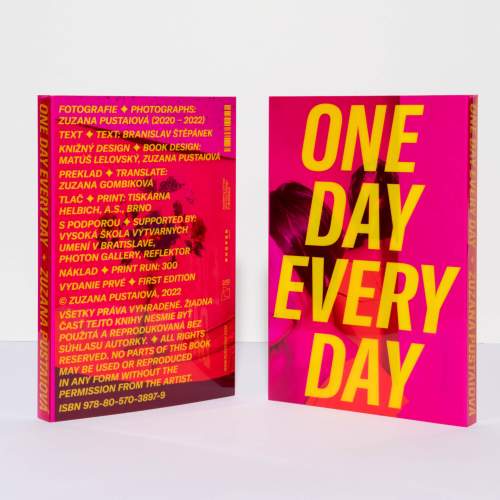 NEW!The debut by Zuzana Pustaiová titled One Day Every Day (2022) is an ironic commentary on various social norms impacting our daily lives. Commonplace routine, gender stereotypes, and role-playing (depicted in the book literally as ‚wearing masks‘) are few examples of cultural code, which, on the one hand, bind the society together, but on the other, it imposes the often unwanted social pressure affecting an individual’s freedom. In this book, the artist seeks the boundary where the (otherwise useful) behavioral patterns become pathological. Exploring the intricate relationship between these patterns and broader social phenomena, the book shows deeper layers of institutional limitations conceived by the policy-makers and relayed to the public by the media and via social networks. It brings the reader’s attention to the point that while striving for a better world, one ought not to forget how the individual feels in the realm of all those recommendations, behests and restrictions, imprinted to one’s mind since an early age and while being brought up, only to find that civilizing imperatives often lead to systematic oppression. The idea of rethinking one’s conviction, when it comes to social norms, is further supported by the ‚Leporello‘ layout, allowing for alternative page juxtapositions. Photographs: Zuzana Pustaiová (2020-2022) Text: Branislav Štěpánek Book design: Matúš Lelovský, Zuzana Pustaiová Print run: 300 + collectors edition of 11 Date of publishing: May 2022 Language: Slovak / English Number of pages: 62 Number of images: 60 Publisher: self-published with Reflektor Supported by: Academy of Fine Arts and Design in Bratislava www.vsvu.sk Photon Gallery www.photon.si Reflektor www.reflektor.org Fond výtvarných umení www.fvu.sk Zoltán Szabó www.raftys.sk Supporters of crowdfunding campaign on www.startlab.sk
